Tobi.com

boutique
the official online boutique of
The Fashion Examiner
get 20% off - use code EXAM20

About Me

My photo
As a nearly 20 year Fashion Industry Vet, I've made TheFE my place to cover and discuss everything fashionable from books, to designer ready-to-wear to couture. All aspects of a fashionable lifestyle are included. BIG NEWS: I'VE MOVED TheFE TO WORDPRESS to take advantage of their superior publishing platform. http://thefashionexaminer.wordpress.com See you there!!

Twitter

Showing posts with label Fashion V. Clothes Series. Show all posts

Wednesday, November 3, 2010

Fashion V. Clothes: Post #6: Adriana Lima + Victoria's Secret- Lingerie, the Foundation of Fashion


Bookmark and Share


TEXT, VIVIAN KELLY

Unless you've been hiding in a log cabin with no connection to the outside world, you have not heard about the Victoria's Secret, and the VS "Angels". The VS Show the Angels walk in typically crashes sites worldwide because of so many page views.
One of the Angels who's responsible for generating this level of frenzy is Adriana Lima.

The opportunity to interview her presented itself at an exclusive press event at the Soho, NYC store I recently attended. The thrust of the event was that Adriana would be in New York to preview the $2 Million Bombshell Fantasy Bra to the press and to tourists lucky enough to be in the neighborhood, when she hit the Red Carpet in front of the store, wearing the bra, a blue silk dressing gown, and white leather opera gloves. The bra boasts an astounding 60 carats of diamonds and 82 carats of sapphires and topazes, laid-out in a constellation pattern. The whole thing is set in 18-karat white gold.

Naturally, she’ll also be wearing it on the runway at the 2010 Victoria’s Secret Fashion show that will air Tuesday, November 30 (10/9C) on the CBS Television Network. The $2 Million Bombshell Fantasy Bra will be featured in the 2010 Victoria’s Secret Christmas Dreams & Fantasies Catalogue that hit mailboxes on October 20th. If the Bombshell Fantasy Bra is out of your price range, you can pick-up the Miraculous Push-up Bra and matching V-string embellished with pink iridescent crystallized Swarovski elements for $250 and $50 at VS stores nationwide.


While I wanted to see what the $2 million diamond bra designed by Damiani looked like, I was most interested in the opportunity to find out what Adriana - the world-famous VS Angel thought about lingerie.
I asked her only one question - Does she consider lingerie to be fashion or is it something completely apart from fashion? I was gratified to receive a full [nearly 2 minute response].


[click on the video for a close-up view of the bra's design and to hear all of Ariana's response to our question: "Is lingerie fashion?"].


I was especially keen on speaking with THIS Angel, because she's had a multi-dimensional career. True, she's responsible for selling millions of dollars of bras and panties for Victoria's Secret, and is a regular cover girl on GQ and other lad mags, but she's also walked on some of the most prestigious runway shows in the world, wearing fashion. No one would dispute that Marc Jacobs' designs for Louis Vuitton are fashion, not clothes.
While I waited my turn in the back of the Soho store, which had been roped off for the press and film crews, I tuned-into what HuffPo and E! asked the stunning Brazilian. Unsurprisingly, they all wanted to know how she'd managed to get her killer body back after having a baby less than a year ago. Answer: Good nutrition and exercise. She dropped a tip about jumping rope in her hotel room that got a good laugh when she confessed to being concerned about her poor neighbors downstairs].
Another question – “How did it feel to wear a $2million bra? [“Amazing”]. Unsurprisingly, she purred on camera that she was “very happy to be walking the show this year and had really missed doing the show last year”.

While these questions are certainly relevant to the event [the unveiling of the $2million fantasy bra], I hoped that my questions would give her a break from the usual ones she gets thrown at her.
Adriana took my questions seriously, and stated that she considers "all creations to be fashion".

Later, while editing the interview voice notes, I decided that she was right – it’s
hard to argue that lingerie is not fashion. After doing some research, I learned from www.randomhistory.com,that " the first record concerning lingerie came from way back around 3000 B.C... Egyptians considered clothing to be a status symbol and the higher-ranking women would wear narrow tunics as undergarments that started below the chest, extended to the ankles, and were supported by a crosswise shoulder strap. Sometimes they would draw tunics around to the front of the body to mold the waist. Slave and servants wore no undergarments; only simple loin cloths or [they just] went naked."
A thousand years later, in 2000B.C. , the prototype for the push-up bra was born. "A female figure from 2000 B.C., found in Crete, depicts the first recorded corset-like bodice and crinoline (a caged or hooped underskirt) that shoves the bare breast upward. Both are interesting in that they show similarities to lingerie eons later in the western world."
The obvious icons are today’s Angels.
Lingerie continued to enjoy popularity throughout the ages. Fast-forward in our time machine to the importance of Corsets during Elizabethan Times. Remember ‘those ‘Tudors’ episodes, when even King Henry occasionally had trouble peeling off all of the elaborate undergarments of his latest noble bedmate?

Centuries later, around the time of the Great Depression and during the World Wars, women [including my French Grandmother] resorted to drawing a black line extending from their heel to just under their buttocks to emulate the silk stockings

they could no longer afford during this time of deprivation. The glamorous twenties' Flappers had made silk stockings a must-have item. True, they'd been around since the mid 1600's, but the Flappers played a big role in popularizing what was previously only for wealthy women. The delicate silk stockings snagged and were costly to replace. Once rayon came along and women of all classes could wear stockings.
Next to get its moment in the spotlight was the bra.
Howard Hughes [then an aeronautical engineer] gave the bra biz a big boost when he designed a bra for Jane Russell
that made her seem even bustier than she already was. Hollywood couldn’t get enough of stars
such as Lana Turner and their ample cleavage. Lana became known as the “Sweater Girl” because of her famous cone-shaped brassieres, and Marilyn Monroe ‘s cleavage helped cement her rep as one of the sexiest fashion icons of all time. Marilyn loved her Chanel No. 5 and her silk stockings. She was also careful to show her famous 36D’s to best advantage in a then-futuristic sling-strapped bra that gave her the lift and separation the modern day Wonder Brad does today. The open top gave the illusion that her famous bosom defied gravity without any help.
*Fun Fact: Marilyn’s cream-colored double-cup bra
sold for $5,200 by London auction house International Autograph Auctions. The winning bid was from an unidentified caller in Hong Kong.
The seventies were a wash lingerie-wise as women took pride in not wearing bras, but that changed in the body conscious eighties. While in Grad School, working part-time at the Limited, I was intrigued by the tiny Victoria's Secret store that had just opened in New Orleans. It was 1985, and the VS store was tiny but the women who worked there were excited in that way that you know you're looking at something that is going to blow-out in a big way. No one though, could have predicted just how huge the brand would become.


Every curious, I asked the women what the name meant. Was it an English brand they were bringing over? They said that it was supposed to sound British and hence "upper class" and that the "Victoria" part was made-up. There was no actual Victoria. Disappointed, I still liked the idea. Apparently, so did the rest of America. Today, VS is North America's #1 specialty retailer of women's intimate apparel, and there are 1,040 [mostly mall-based] Victoria's Secret stores. According to www.biz.yahoo.com, last year, VS reported revenues of $5604.00M.

The splashy annual runway show and the Angels ads and signage help to generate these blockbuster dollars.
Unsurprisingly, like major athletes, the Angels are well coached as to how best to represent the brand. Being the good spokesperson that she is, Adriana talked about the importance of the right bra/undergarments while wearing fashion. To my surprise, she did not plug a specific VS bra, but instead talked about how the smooth line of the right bra can show off a designer garment to best effect.
Adriana showed her human side by confiding that she had not chosen the right bra for a very beautiful dress she'd recently worn and had regretted it, not feeling comfortable. If one of the world's most beautiful women and experienced models can make an error like this, just remember that next time you choose the wrong undergarment. Part of being fashionable is looking put together, or as C.Z. Guest
said, “well turned-out.”
Lingerie matters, Monroe knew it and would not have dared make a public appearance without the right bra on underneath her skintight dresses. Take a cue from Marilyn, and take the time to choose the right bra, panty or body slimmer that will show your special dress to its best advantage. The options these days are through the roof at VS. There are collections of bras to choose from: The Very Sexy, The Bio Fit, The Nakeds, The Incredible, The Angels. There are also entire floors of luxury department stores dedicated to stocking foundation garments for every possible garment you could choose to wear. With the vast resources available today, there is no excuse for a bra strap on thong to peek out of your designer outfit. Being fashionable and put together starts with choosing the proper foundation garments. Without these key pieces, even the most beautiful fashions are diminished into nothing more than just expensive clothing.

Friday, October 29, 2010

Fashion V. Clothes: Post #5: The Branding Game


Bookmark and Share

TEXT, VIVIAN KELLY
If you are a dyed in the wool fashionista, fashion is your religion. As such, you must abide by the fashion commandments. Perhaps the most important fashion commandment is: “Thou Shalt Not Over-License”. The danger that comes from over licensing is that it devalues fashion, whether it be RTW, belts, bags, and shoes and turns them into mere clothes and junky accessories.

The most glaring and well-known example of a fashion designer guilty of defying this commandment is Pierre Cardin, the subject of this column. [I’ll save Halston and the J.C. Penney debacle for another day].
I hadn’t though much about Pierre Cardin since High School, when one of my favorite pieces of jewelry was a gold plated “Pierre Cardin” necklace. Back then, I didn’t know much about M. Cardin other than: he was French, one could buy designer items from him at Bloomingdales’, and it was cheaper than the Gucci bag and LV monogram bags I lusted after.
Cardin products were so available, and even then, in the back of my mind as the sales clerk rang the register for that necklace, I wondered, ‘Is this really a designer item? Shouldn’t it be harder for me to get this?’ The supply and demand aspect of making an item exclusive fashion [or just clothes] is a difficult tight rope for designers to walk when they’re seeking to brand themselves.
M. Cardin will forever be remembered as the man who opened-up the Pandora’s box of branding. His empire included everything from haute couture to sardines, and boy, were they ever available! You could purchase Cardin designs anywhere and everywhere, from the Midwest to the Far East. In 2000, his empire was estimated to be worth$4.97billion and he had 190,000 people working in 840 factories. The amount of money his brand generated is mind-boggling. The obvious lure to designers to go the brand extension route is the huge amount of money branding oneself can generate. But then there’s that matter of exclusivity. As a designer, you need to ask yourself a few questions. 1. Am I over-extending myself to the point that I’m no longer creating fashion?' 2.Have I lowered my standards to the point that I'm just cranking out mediocre products with my label slapped on it that will only sell to gullible duty free shoppers who will buy it as long as there's a designer label slapped on it?
3. Is this how I really want to be perceived?
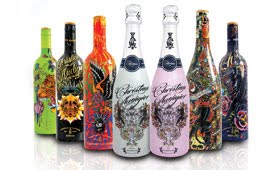
As a consumer, when shopping for say, a bottle of olive oil, I have to ask myself, ‘Do I really want to buy a bottle of olive oil because it has “Pierre Cardin” scrawled across it rather than a bottle of Sclafani or Bertolli?’ For that matter, last weekend I passed on a bottle of “Christian Audigier Vodka”,
even though it was on sale for $25 in favor of the tried and true Absolut. Also, what business does a fashion designer [or Donald Trump for that matter] have “designing” a consumer staple other than to make a buck? It’s not the kind of thing that earns you respect in the fashion business, nor does it have anything to do with fashion. I can’t imaging that fashion designers such as Duckie Brown will be coming out with a “Duckie Brown balsamic vinegar” anytime soon.
Availability kills the notion of exclusivity. Even back in the late seventies, I wondered why it was so easy to pick up a piece of designer – anything. Back then; the word “designer” really did connote exclusivity. The New York Gucci store closed its doors during the office lunch hour, because they didn’t want secretaries and sales assistants coming in to buy. The Ladies of leisure were actually lunching at that time, and had the rest of the day until cocktails to shop.

This past season, when Tom Ford tried to bring that concept back, I gave him a mental high-five. There’s a fly in the ointment though. While I love the idea of fashion being exclusive, I don’t love the idea of being excluded from the party. As I jokingly said to PR Paul Wilmot a few weeks after Tom’s show, “I did not make the list, nor did I expect to, but I sure wanted to be on it.”
Taking it beyond fashion for just a moment, Groucho Marx had a point in his infamous remark, “I don't care to belong to a club that accepts people like me as members. ”
While I could buy Pierre Cardin – just about anything – I don’t want to, because so can anyone else. A logo should mean something. A Birkin bag still holds that allure of exclusivity because you just don’t see a lot of them unless you happen to be walking on Fifth Avenue, up by Bergdorf’s.

“Logomania” put a big dent in designer exclusivity.
Logomania was that horrible moment circa 2002 that was dubbed thusly because of the inordinate number of logos consumers were encouraged to wear. The mantra was “the more, the better!”
Logomania represented the total opposite of what Mr. Ford was trying to achieve with his hyper-exclusive presentation. It was as if designers opened the door to what was once a very private club and invited anyone and everyone who could afford to pay the door fee inside. On the darker side, it also generated a huge wave of designer knock-offs. You’d be on the #6 subway going downtown, and every other woman riding was wearing something with a GG or LV or CC emblazoned on it.
I recall flipping through the pages of Vogue, aghast at this reigning trend. It looked “common” as the British so disdainfully put it. I continued to cringe as that particular fashion week, when fashionistas proudly donned designer logos on every square inch of their bodies. All those logos devalued the brand, what’s exclusive if everyone’s wearing it? The most heinous example was a long Louis Vuitton logoed coat. While I can’t recall who wore it, I sure remember the coat – ugh. It was Louis Vuitton but I couldn’t image a fashion icon who wore LV, such as Audrey or Jackie wearing this piece, not even on Halloween.

This is not to say that tasteful branding is not possible. Designers such as Bill Blass and Ralph Lauren have proven that theory out. Mr. Blass was the first to successfully put some “class” into branding. A few years later, Mr. Lauren started his empire, which is probably now the biggest fashion branding success story ever. [Mr. Lauren deserves an article all of his own, which I’ll be tackling later, after a visit to his newest NYC store.]
Mr. Blass “had it all”, and was responsible for helping lead the way for others such as Ralph and Tommy [Hilfiger] to create their multi-billion dollar empires built on “the world of [Tommy, Ralph]. A notable exception to outside logos “working” was Ralph’s RRL line. Somehow, wearing RRL to the gym was not…. Embarrassing, nor did he lose his fellow CFDA members’ respect for doing RRL.

Bill Blass had his fellow designers’ respect because he dressed fashion and society’s elite such as Jackie Kennedy, Nancy Reagan, Barbara Harriman, and Happy Rockefeller.

His Bill Blass Collection designs
retailed in all the best stores: Bonwit Teller, Lord and Taylor, and Neiman-Marcus and he made money – a lot of it. Unlike M. Cardin, though, no one ever accused Mr. Blass of being foolish or greedy in his brand expansion.
On the more commercial [yet still fashionably so] was the beige Chantilly-lace dress he created for model Jean Shrimpton for a Revlon lipstick ad that thrust him even more in the limelight.
In 1968, he took the next big step and established a Rentner licensing and franchising subsidiary, Bill Blass Inc.
Unlike M. Cardin, he carefully picked and chose what he would design.
There were: shoes, hosiery, scarves, gloves, luggage, jewelry, and wristwatches, and a car. He designed the “Lincoln Mark VII Bill Blass Model” from 1984-1992. Back then, a Lincoln was perceived as an elegant Town Car. The Ladies Who Lunched rode in them to get from their Park Avenue homes to La Grenouille and Mortimer’s. When he added furniture to the equation, Blass completed the circle of “the world of”.
His own homes, the 22 acre estate in New Preston, CT, and Sutton Place pied-a-Terre, were familiar to the society women he dressed and entertained. Unsurprisingly, in 1997, he made a deal with Pennsylvania House, and introduced a 50 piece Bill Blass furniture collection. A few years before his death, he’d pared his licenses down to 42, before selling it all in 1998. His final presentation in the Bryant Park Tent was theatrical and the most memorable fashion show I have ever attended.


All of his “ladies” showed and proudly watched, rapt, in the front row. There wasn’t a dry eye in the house, as we all knew this was Blass’s swan song. It there ever was a fashion moment; this was it.


Taking things back to the present, how about Pierre Cardin? When Assouline’s Mimi Crume sent me the digital version of Pierre Cardin: 60 Years of Innovation to review, I resolved to go and see the real book before reviewing it. My chance came during FNO at the Assouline Party at the Plaza.
Flipping through the book was like savoring a gourmet meal – it’s an experience that’s not to be rushed. Half an hour later, I reluctantly left to go uptown to Missoni, reflecting on some of M. Cardin’s groundbreaking designs.

The book was a fitting tribute and wonderful retrospective of a singular career. This is the part where the credits should roll and say “THE END”.
To my dismay, I read in WWD.com and I meanwhat.com that M. Cardin wanted to keep going and going…. And going.
Question: Who ITALS puts on a show with 200 looks?
Answer: No one in their right mind, that is no one who would like to keep their over-scheduled audience of editors and retailers from nodding off after look #50.


As Fashion Pundit, Abe Gurko
so aptly said, “Far be it from me to not have the utmost respect for the man who changed the industry. After all, he made pens chic. With his ground-breaking contribution to licensing coupled with his reputation for futuristic fashion, at a time when Cosmonauts were circling the globe, Cardin tapped into the zeitgeist of the 60’s and etched his place in fashion history.”

Silly circus show or not, I still want the book, because at that point in time, M. Cardin designed fashion, not clothes.
Pierre Cardin: 60 Years of Innovation, takes you from M. Cardin’s early years, working for in 1946, to the opening of his own couture house in 1950, and shows some of his most memorable architecturally futuristic fashion.
Prosper & Martine Assouline celebrated Pierre Cardin and the U.S. launch of his book Pierre Cardin: 60 Years of Innovation with a cocktail reception and book signing at the ASSOULINE boutique at The Plaza Hotel, on Tuesday. As I couldn’t make it, I immediately bought a copy online, to make sure I’d have one for my home office collection. Looking throught the book, I can take pleasure in viewing the designs that made M. Cardin one of fashion’s greats and forget about the olive oil and sardines for a while.

Wednesday, October 13, 2010

Neiman Marcus' Ken Downing: Fashion V. Clothes, post #4

Bookmark and Share


TEXT, VIVIAN KELLY, w/ Contributions by Mark Behnke of www.fashiontribes.com

We caught up with Ken Downing, Neiman Marcus’ SVP and Director for Stores, to get a retailer’s perspective on Fashion V. Clothes outside the Catherine Malandrino presentation. I say “outside” which made it all the more frustrating, even for heavy-hitters such as Ken. The crowd of onlookers was so thick, that even Ken had problems getting into the cordoned-off viewing area. Once I secured a spot, it seemed that the media-genic Malandrino, who’s been tapped to design Lacoste, over-indulged her inner hippie. Much of what she designed appeared to be mostly crochet garments that looked…odd, even on the sub-size zero models posing in the Lincoln Center courtyard.


Ken made the droll comment, “Women do not want to look like they just dipped into a vintage trunk to get dressed.”


He went on to say that his customers text and email him constantly, asking him what he thinks is new and great, and most importantly, is there something for them he’s seen? They’re very conscious of what designers are showing, but they rely on him - heavily - to make sure they look trendy, but not like foolish fashion victims.
Ken’s experience at Neiman’s is similar to the one Ballietes’ co-owner, Bob Benham,
has but on a somewhat smaller scale.
Bob told us he also gets texts and calls on his phone about special pieces his best clients want after they’ve viewed the latest styles on sites such as www.style.com. He hedges his bets by collaborating with similar high-end specialty stores. Lela Rose is one of the biggest sellers in his Oklahoma City based boutique.


Fortuitously, right after our chat with Ken, I was able to get a good look at one section of the Malandrino presentation. What I saw was dismaying - crochet sweaters that were a way too literal take on the “flower power”
years, and frayed leggings


that looked like something a Bon Jovi groupie might have worn back in the eighties. It is extremely hard to believe that sophisticated women in New York, Boston, D.C., Chicago or Dallas would want to blast back so literally to the past. A reference is just that, a reference, not a straight-out reinterpretation of the past.
While it’s commendable to try something different, the risk is that a designer [as we witnessed at Sinister] can fall flat on their face doing so. This brings to mind joke about the "cutting-edge" sweater with three arms. Why?? Who is actually wearing that?

Vintage can be done right. Fashion has been preoccupied with vintage and many fashionable women have worn vintage pieces with pride and looked great. I'll be discussing that some more in a post later this week, which features Joanna Mastroianni and Elene Cassis. The Look On Line’s Marilyn Kirschner
always looks amazing and I can’t remember a day I haven’t seen her wearing something vintage. She is one of The New York Times Bill Cunningham’s favorite subjects to snap because of her highly individual style. The word “something” is key. Marilyn’s look works because she incorporates vintage into her look and does not wear it literally, or look like she fell into the vintage bin. In the end, if the women reject it [the collection], it’s clothes. If they accept it, it’s fashion.